Will the glass physically fit?
Check the total length, maximum diameter, neck profile and clearance around the holder or shade.

Practical Guidance for Custom Decorative Bulb Projects
Product-based information for lighting brands, distributors, designers, contractors and commercial project buyers.
Choose a glass bulb shape by starting with the fixture, available space, viewing angle and intended visual presence—not by product name alone.
This practical guide helps lighting brands, wholesalers, designers, contractors and project buyers compare familiar decorative bulb families and prepare the information needed for product, sample and specification review.
A decorative bulb is part of the fixture composition. A shape that looks balanced in an open pendant may be too tall for a shade, too wide for a cage or visually weak when installed high above the floor.
Before comparing glass styles, record the physical and visual limits of the application. This avoids selecting a product that photographs well but does not fit or read correctly in the finished installation.
See the project checklist →Check the total length, maximum diameter, neck profile and clearance around the holder or shade.
An exposed bulb needs a considered silhouette. Inside a shade, proportion and light distribution may matter more than decorative detail.
Long tubes can create a strong vertical rhythm; globes and special shapes may need more spacing to avoid visual crowding.
Confirm the silhouette, scale, glass finish, filament position and installed appearance—not only whether the bulb switches on.
These are real GLORILUM product references rather than generated interiors. Use them to discuss proportion, glass form and product direction; final dimensions and electrical specifications still require product-specific confirmation.
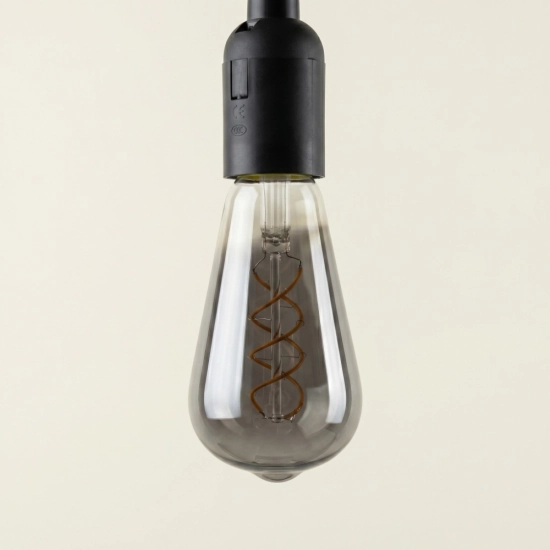
A familiar decorative form for exposed pendants, table lamps and wall fixtures where the bulb should feel recognizable and balanced.
View ST64 product →
Useful for slim pendants, bars, shelving and grouped installations where vertical proportion is part of the composition.
View tubular product →
A broad, calm silhouette for open shades, table bases and pendants where a larger visible glass volume is appropriate.
View globe product →
A slimmer option for decorative wall lights, chandeliers and compact hospitality fixtures where space is limited.
View candle product →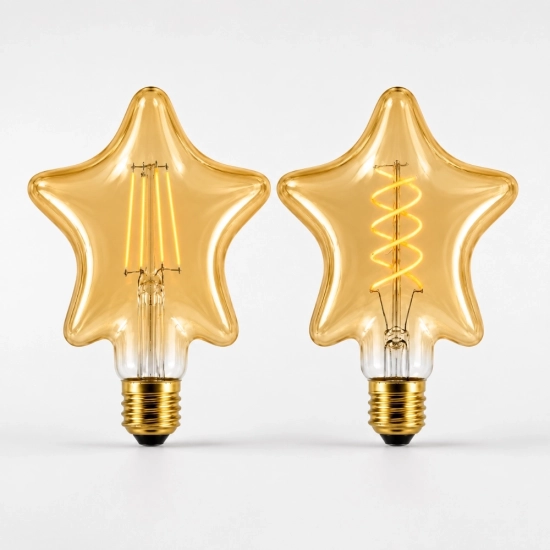
For themed displays, hospitality concepts and branded interiors where the glass outline itself becomes a visible feature.
View star-shaped product →
A front-facing form for custom letter or pattern concepts where the viewing direction and filament layout are central to the design.
View flat globe product →This table is a practical starting point, not a universal specification. The final choice depends on the exact fixture, product dimensions and target-market technical requirements.
| Shape family | Common project use | Visual character | Confirm before sampling |
|---|---|---|---|
| ST64 Edison | Open pendants, table lamps, wall lights | Familiar, warm, balanced | Shade opening, bulb length and filament visibility |
| Tubular | Slim pendants, bars, shelving, grouped drops | Vertical, architectural, linear | Total length, hanging clearance and spacing |
| Globe | Open shades, table bases, decorative pendants | Broad, calm, high visual volume | Maximum diameter and balance with fixture scale |
| Candle / flame tip | Chandeliers, wall lights, compact fixtures | Slender, refined, traditional | Base type, socket depth and shade clearance |
| Distinctive glass form | Themed displays, hospitality, branded interiors | Expressive, object-like, memorable | Viewing distance, orientation and glass feasibility |
| Flat display form | Letter, logo or pattern-led concepts | Front-facing, graphic, directional | Viewing angle, filament layout and installed rotation |
The same filament can look different inside a narrow tube, broad globe or flat display bulb. Likewise, clear, amber, smoke gray, painted or diffused glass changes how strongly the silhouette and internal light source are perceived.
Continue to the Glass Color Guide →Wider clear glass exposes more of the internal layout; narrow or diffused glass can make it quieter.
The bulb should feel intentional relative to the socket, shade, cage and surrounding materials.
Flat and directional products need the correct rotational position when viewed from the intended side.
Multiple visible bulbs require enough separation for each silhouette to remain legible.
A custom request can begin from an existing family, a reference sample, a dimensioned drawing or an original form. Feasibility, tooling, tolerances, sample route and commercial terms depend on the actual design.
Review available dimensions, finish, filament, electrical specification, labeling and packaging around an existing product structure.
Discuss whether a current shape can support a different size, finish, filament layout or project-specific appearance.
Share references and target dimensions so the team can evaluate geometry, glassmaking approach, orientation and repeatability.
You do not need every answer before contacting us. Share the information already available and identify which points still require product or engineering review.
Send your project information →Short answers to common questions before a product or sample review.
No. Shape, base, voltage, frequency, wattage and dimming are separate specification items. They must be confirmed together for the selected product and destination market.
Provide the fixture drawing or photo, socket position, shade or cage opening, maximum available length and diameter, and any enclosed-space limitations. A physical sample may still be needed for final approval.
Often there are multiple appearance directions, but availability depends on the individual product structure. Confirm the glass finish, filament layout and light effect using the relevant product or sample.
New-form requests can be reviewed from drawings, dimensions, reference samples or concept images. Manufacturing feasibility, tooling, tolerances, sampling and quantity requirements are evaluated case by case.
For custom or project-specific work, a sample helps confirm scale, silhouette, glass appearance, filament position, electrical function and packaging direction before the production specification is finalized.
Send the fixture information, target dimensions, preferred appearance, electrical requirements and estimated quantity. We will use them as the starting point for a practical product discussion.
Direct email: custom@glorilum.com