Check it switched off
Review the glass body color, transparency, surface uniformity and how it relates to the socket, shade and interior materials.

Practical Guidance for Custom Decorative Bulb Projects
Product-based information for lighting brands, distributors, designers, contractors and commercial project buyers.
Compare clear, amber or champagne, smoke gray and specialty glass by what the buyer will actually see—both switched off and illuminated.
Glass color affects filament visibility, perceived brightness, reflections and the appearance of the bulb inside the fixture. This guide helps lighting brands, wholesalers, designers, contractors and project buyers prepare a finish direction that can be confirmed with a physical sample.
“Amber,” “champagne,” “tea” and “smoke gray” can be interpreted differently across products, suppliers, glass thicknesses and photographs. A screen image cannot serve as the final approval standard.
The practical goal is to define what the finish should do in the actual fixture, then confirm the selected product under agreed viewing conditions.
Review the glass body color, transparency, surface uniformity and how it relates to the socket, shade and interior materials.
Confirm filament visibility, perceived warmth, glare and whether darker glass makes the result too subdued for the application.
For grouped pendants or open displays, compare multiple samples side by side so visible variation can be discussed before production.
Keep the approved sample, product code and specification together for production and future repeat-order communication.
These descriptions are decision guides, not universal color standards. Final appearance depends on the bulb shape, glass process, filament, light color, output and surrounding fixture.
Best when the filament layout and internal construction should remain highly visible.
Adds a visible warm tint when off and can make the illuminated product appear warmer.
Creates a darker off-state appearance and reduces how directly the internal filament is seen.
Softens or conceals the internal structure and changes the bulb from a filament object into a glowing form.
Introduces stronger surface color, reflection or decorative variation for selected visual features.
Begins with a reference, target effect or approved existing sample and requires a feasibility review.
Use this table to narrow the discussion before requesting samples. It does not replace product-specific technical review.
| Glass direction | Typical unlit appearance | Filament visibility | Buyer should confirm |
|---|---|---|---|
| Clear | Transparent and visually light | High | Reflections, glare, internal details and installed sightlines |
| Amber / champagne / tea | Warm tinted body | Medium to high, product-dependent | Actual tint depth, light color interaction and material matching |
| Smoke gray | Darker neutral or cool-toned body | Reduced | Perceived brightness, daytime appearance and grouped consistency |
| Frosted / opal / painted | Opaque or diffused surface | Low | Surface uniformity, transmission and cleaning or handling needs |
| Iridescent / stained | Reflective or multi-color decorative effect | Variable | Viewing angle, unit-to-unit appearance and surrounding reflections |
| Custom color | Reference-based project finish | Defined during sampling | Feasibility, approved sample, tolerance, quantity and repeat-order record |
A finish cannot be judged in isolation. The glass geometry, internal light source and surrounding materials all change what the buyer sees.
Continue to the Filament Design Guide →Curves, edges and different glass volumes can make the same tint appear lighter, darker or less even.
A bright central filament, a letter pattern and a wide spiral do not read the same behind tinted glass.
The relationship between the glass tint and visible filament changes across the operating range.
Brass, black metal, wood, mirrored surfaces and colored shades alter contrast and reflected color.
A bulb can look substantially different in daylight, a dark bar, a hotel room or a brightly lit retail display.
White balance, exposure and display calibration make photographs useful for direction—but unreliable for final color approval.
Use these real product photographs to identify a starting direction. Confirm the actual product, finish availability, electrical specification and sample route before ordering.

A transparent reference where the filament and internal structure remain directly visible.
View product →
A broad tinted globe reference for comparing warm glass color with a larger visible glass volume.
View product →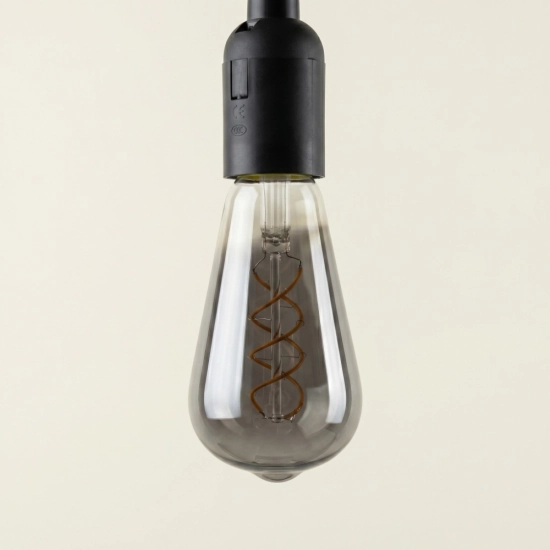
A classic Edison silhouette for reviewing tinted glass, filament visibility and grouped installation appearance.
View product →
A useful product family for comparing several finish directions on a related tubular form.
View product →
A stronger decorative surface direction where color variation and viewing angle are part of the intended effect.
View product →
A reflective specialty finish whose appearance changes with angle, surrounding light and nearby materials.
View product →Not every project needs a newly developed color. Starting with an existing finish is often the clearest route; adapted and project-specific colors require more detailed review.
Confirm the finish on the exact bulb shape, then review filament, electrical details, labeling and packaging.
Share a product reference and explain what should be lighter, darker, warmer, cooler, more transparent or more diffused.
Provide a sample, material reference or color direction together with the bulb shape, quantity and intended application.
Review the sample in the intended fixture and document the conditions used for approval. This is especially important for open lamps, multi-bulb groups and repeat-order programs.
Prepare a sample request →Short answers to the questions buyers should settle before approving a glass finish.
Not necessarily. These names describe a general warm-tinted direction, but the exact hue, density and transparency can differ between products and suppliers. Approve the finish on the actual bulb sample.
Darker glass can reduce filament visibility and perceived brightness, but the result also depends on the filament, output, shape, dimming level and ambient light. Test the complete product in the intended fixture.
A Pantone or digital color can help communicate a starting direction, but it does not predict the exact appearance of transparent or illuminated glass. Manufacturing feasibility and final approval should use a physical sample and agreed tolerance.
No guarantee should be assumed. Curvature, glass thickness, surface area and production process can change how a tint appears. Compare samples on the intended shapes when multiple families are used together.
Review several units side by side in the actual fixture or a representative mock-up. Check both off-state and illuminated appearance, then record the approved sample and product specification.
Selected products can support multiple appearance and electrical options, but the whole combination must be reviewed as one specification. Confirm the bulb shape, glass, filament, base, voltage, frequency, dimming and target market together.
Send the bulb shape, fixture or application, preferred color direction, electrical requirements, quantity and target market. We will identify the next product and sample questions.
Direct email: custom@glorilum.com